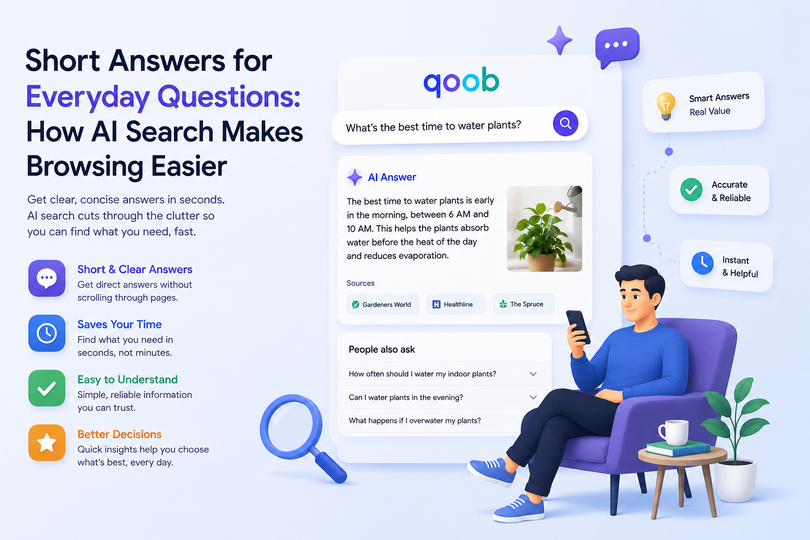

The internet has made it easier than ever to find information. A quick search can provide thousands of results, articles, videos, product pages, reviews, and opinions within seconds. However, having access to more information does not always mean finding an answer is easier.
For many everyday questions, people do not need hundreds of search results. They need a clear answer that helps them understand the topic and decide what to do next. This is where AI search and short answers can make a meaningful difference.
AI powered search is changing the way people interact with information. Instead of relying only on keywords and browsing through multiple pages, users can ask questions naturally and receive information organized around their intent.
For users who want a simpler way to find short answers to everyday questions, Qoob Search offers an AI search experience focused on clear, useful responses and everyday decision making.
What Are Short Answers?
Short answers are concise responses that focus on the most useful information related to a specific question. They are designed to help users understand something quickly without requiring them to read several lengthy webpages.
A short answer does not necessarily mean leaving out important information. The goal is to remove unnecessary details while keeping the context needed to understand the response.
Traditional search often requires users to become researchers. They need to compare sources, identify useful information, and decide which result answers their question. AI search can reduce some of this work by organizing information into a more direct response.
Why Concise Information Matters
People search for information throughout the day. Many of these searches are simple and practical.
For example:
- What can I cook with the ingredients I have?
- Which product is better for my needs?
- What should I pack for a weekend trip?
- What are some activities I can do today?
These questions usually do not require extensive research. A focused answer can help users move forward faster.
How AI Search Makes Browsing Easier
AI search uses artificial intelligence to understand the meaning and context behind a user’s query. Instead of focusing only on individual keywords, modern AI search systems can interpret complete questions and conversational requests.
This makes searching more natural.
For example, a person can ask, “What is a good laptop for working from home under a specific budget?” rather than searching separately for laptops, specifications, prices, and remote work features.
Natural Language Makes Search Simpler
Traditional search techniques often encourage users to think about which keywords will produce the best results.
AI search allows people to describe what they need in a more natural way. This can make the process easier for users who are not familiar with advanced search techniques.
The more context a person provides, the easier it can be for an AI search tool to understand the purpose behind the question.
Short Answers Can Save Valuable Time
Time is one of the biggest reasons people prefer concise information.
A traditional search may require users to open several pages before finding a relevant answer. They may encounter advertisements, repeated information, lengthy introductions, or content that only partially addresses their question.
An AI search experience can help reduce these steps by presenting the key information first.
Less Scrolling and Fewer Tabs
Short answers can reduce the need to jump between multiple websites for basic questions.
Instead of opening ten tabs to compare information, users can begin with a concise response and then explore further if necessary.
This can be especially helpful when someone is researching something during a busy day and needs a quick starting point.
AI Search Helps Reduce Information Overload
The internet contains an enormous amount of information. While this is useful, it can also create information overload.
When people see too many results, they have to decide which sources deserve their attention. They may spend more time evaluating search results than solving the original problem.
Short answers can simplify this process by focusing attention on the most relevant information.
Focus on What Matters
A useful answer should address the question directly.
If someone asks for a comparison, the answer should highlight meaningful differences. If someone asks for recommendations, the response should explain why the options may be suitable.
The objective is not to provide the longest response. It is to provide information that is useful for the specific question.
Everyday Shopping Becomes Easier
Online shopping is one area where search can quickly become complicated.
A single product category can contain hundreds of options. Customers may need to compare prices, specifications, features, reviews, sizes, and alternatives before making a decision.
AI search can help organize this research around the user’s actual requirements.
Comparing Products More Efficiently
Instead of searching for each feature separately, users can ask an AI search tool to explain which type of product may be appropriate for their needs.
For example, a user might ask which device is better for working remotely, casual entertainment, and video calls.
The response can provide a starting point for comparison. However, users should still check official product information, current prices, and specifications before making an important purchase.
AI Search Can Simplify Travel Planning
Travel planning often involves a large amount of research.
People may need to compare destinations, transportation, accommodation, activities, restaurants, budgets, and schedules. Searching for each piece of information individually can take considerable time.
AI search can help users begin with a broader question and refine it through follow up searches.
Turning Travel Ideas Into Plans
A traveler might ask for ideas for a short weekend trip based on their budget and interests.
A useful AI search experience can organize potential options and highlight relevant considerations.
Users can then ask additional questions about transportation, activities, or the best time to visit.
This creates a more conversational research process instead of requiring users to start a completely new search for every detail.
Short Answers Are Useful for Learning
Short answers are not only helpful for everyday decisions. They can also support learning.
Students and curious users often encounter unfamiliar concepts while reading or studying. Instead of immediately opening multiple resources, they can ask an AI search tool to explain a concept in simple language.
Start Simple, Then Explore
A short explanation can provide the foundation needed to understand a more complex topic.
Once the basic idea is clear, users can ask follow up questions to explore details, examples, advantages, limitations, or related concepts.
This approach can make learning feel more manageable because users can build their understanding step by step.
Personal Context Makes Answers More Useful
The same question can have different answers depending on the person asking it.
For example, the best travel destination depends on budget, interests, available time, and location. The best computer depends on workload, budget, and preferred features.
AI search can use context provided in a query to make its response more relevant.
Give AI Search More Context
Users can improve the usefulness of their results by including important details.
For example:
- Mention your budget when asking about products.
- Include your timeframe when planning an activity.
- Explain your experience level when learning a topic.
These details help an AI search tool understand what the user is actually trying to accomplish.
Why Trust and Accuracy Still Matter
AI search can make browsing faster, but users should not assume that every AI generated response is automatically correct.
AI systems can misunderstand questions, use outdated information, or produce inaccurate details. This is particularly important for high consequence subjects such as health, finance, law, or safety.
Short answers should therefore be treated as a convenient starting point rather than an unquestionable authority.
Verify Important Information
For important decisions, users should check reliable and official sources.
A practical approach is to use AI search for discovery and understanding, then verify critical facts before acting on them.
This combination provides convenience while maintaining responsible research habits.
What Makes a Good Short Answer?
A short answer should be more than a few sentences. It should provide enough information to help the user understand the subject.
The best answers are focused on the question rather than filled with unnecessary information.
Key Qualities of Useful Answers
A good short answer should generally be:
- Direct and easy to understand
- Relevant to the user’s question
- Concise but informative
- Clear about uncertainty when necessary
These qualities can make online browsing feel less overwhelming.
Qoob and the Short Answer Approach
Qoob Search is designed around the idea of making search more direct and useful for everyday questions. The platform presents itself as a smart search experience focused on short, trustworthy answers that can help users make everyday decisions. (theqoob.com)
The service focuses on practical use cases such as shopping, travel planning, recipes, leisure activities, and other everyday decisions.
Making Search More Practical
The value of a short answer is not simply its length. Its value comes from how effectively it helps a user understand a question.
A useful response should help users identify their options, understand the key information, and decide whether additional research is necessary.
This approach can make search more focused for people who want practical information without unnecessary clutter.
The Future of AI Search
AI search is moving toward more conversational and context aware experiences.
Instead of treating every search as a collection of keywords, modern AI systems increasingly aim to understand what users mean, what they need, and how different pieces of information relate to their question.
This evolution can make search more useful for everyday activities where the goal is not simply to find a webpage but to understand something and make a decision.
The future of search will likely combine AI generated responses with original sources, traditional search results, personalization, and interactive tools.
Conclusion
The internet gives people access to more information than ever, but finding useful information can still take time. Short answers provide a practical way to simplify everyday browsing by focusing attention on the information that matters most.
AI search makes this approach more powerful by understanding natural language, considering context, and organizing information around the user’s actual question.
Whether someone is shopping for a product, planning a trip, learning something new, finding a recipe, or simply looking for a quick explanation, concise AI powered responses can reduce unnecessary searching and information overload.
Qoob is a smart search brand focused on helping people find useful answers faster and make everyday decisions more easily.